Why Humanoid?
November. 8th. 2026
One of the most interesting keynotes I attended was “Why Humanoid?” by Michael Perry from Persona AI. Persona AI targets heavy industries such as welding, grinding, inspection, and maintenance, with humanoids designed to work across multiple tasks.
Michael pointed out that many structures, tools, and workflows in these environments were originally designed around human workers. In that sense, a humanoid can be a good fit—not necessarily because it should replace humans directly, but because its human-compatible form allows it to work with existing tools and environments without requiring everything to be redesigned for a machine with a very different form factor.
Embodiment as an Interface
This led me to an interesting question.
In physical AI, how a robot looks, behaves, and works is itself part of the interface. For instance, when we look at a robot’s hands and arms—and how they move and manipulate objects—we start to infer and expect what the robot should be capable of doing.
If embodiment communicates capability, what expectations does a humanoid body create—and what happens when its actual capability falls short of those expectations?
For at least the next few years, it is likely that actual capability will fall short of human expectations across many tasks. A humanoid might drop a cup from its grip, struggle to climb stairs, or fail to understand context in the way a human would.
The more human-compatible the form appears, the more important it may become to communicate the boundaries of that capability clearly.
Human–Robot Learning and Handoff
As one robot begins to take on many roles, another question emerges: What should the UX look like when humans need to teach and correct the robot? More simply: How should a human teach a physical skill to a robot?
When more robots enter industrial environments—and when people become more comfortable working alongside them—it does not necessarily mean that robots are ready to take over every task. Instead, it may mean that we are reaching a stage where humans are more willing to teach, correct, and collaborate with robots, while robots become increasingly capable of learning from that guidance.
If humanoids learn from human work, interaction design is not only about commanding robots. It is also about transferring skills, correcting behavior, and deciding when control should move between human and robot.
POV on Robot Ecology
I don’t think humanoids are the single or ultimate answer to robotics. We already see a multitude of robot forms being developed for different purposes, and form should follow function.
In robotics, function is also shaped by the environment in which the robot operates.
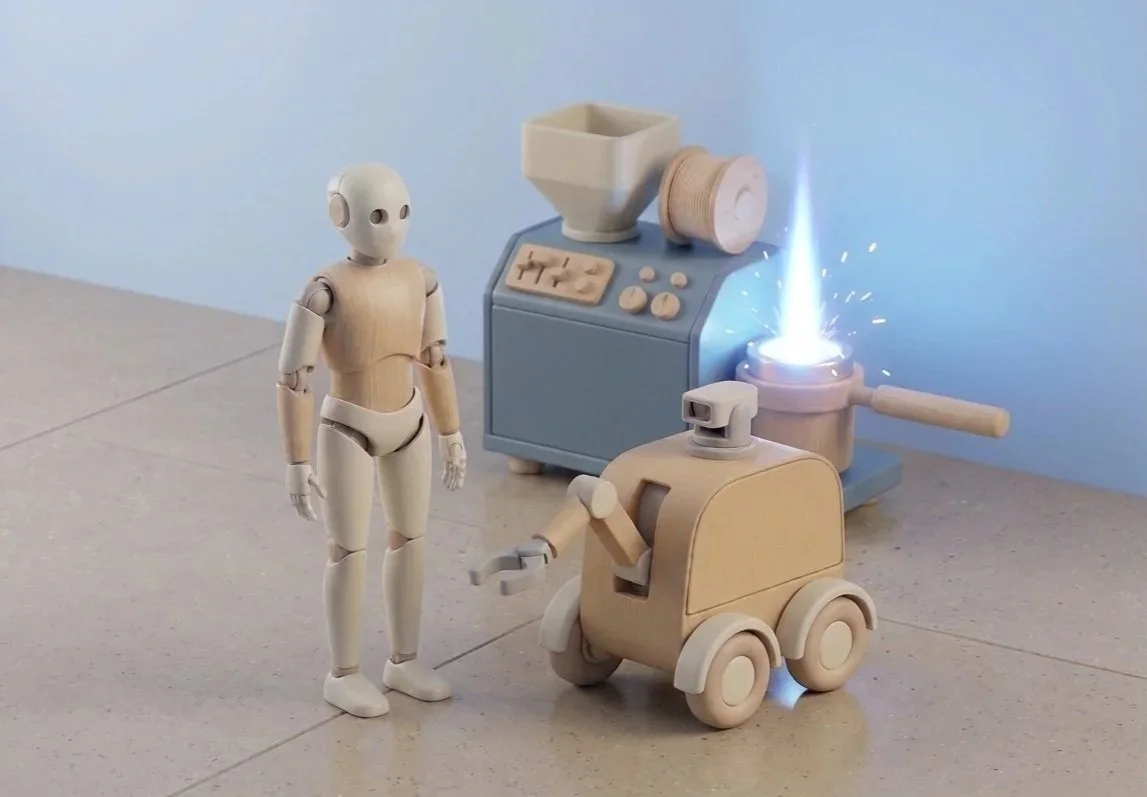
A humanoid may make sense where tools, workflows, and spaces are already designed around the human body. In other environments, a wheeled robot, mobile manipulator, quadruped, or another specialized form may be the better answer.
The question, then, may not simply be “Why humanoid?” It may be: When does a humanoid form create meaningful value—and when does another form make more sense?